How Early Robotics Laid the Groundwork for a Revolution That Kept Reaching
 For years, autonomous driving seemed less like a question of if and more like a question of when. By the middle of the 2010s, the pieces appeared to be falling into place as cars could already see pedestrians and other vehicles, computers could process enormous quantities of sensor data, and deep-learning systems were becoming dramatically better at recognizing objects. Companies such as Google, Tesla, Uber, and a new generation of autonomous-driving startups were investing billions of dollars in the idea that the automobile was about to become something fundamentally different. Industry forecasts were increasingly aggressive, with many placing highly automated vehicles only a few years away, robotaxis and other Level 4 applications in commercial operation during the 2020s, and eventually very large numbers of autonomous vehicles operating across major markets.
While that timeline proved wrong, the underlying story is far more interesting than simply saying that autonomous driving was overhyped. The technology did not disappear; instead, the bottleneck kept moving. What began primarily as a robotics problem became increasingly a software problem, then a data and machine-learning problem, an operational problem, and now, in some approaches, a problem of building artificial intelligence capable of reasoning about the physical world. To understand why autonomous driving took so much longer than expected—and where it may actually be going—it is necessary to go back before Tesla, Waymo, robotaxis, and even the current generation of AI.
Before the Startups, There Was DARPA
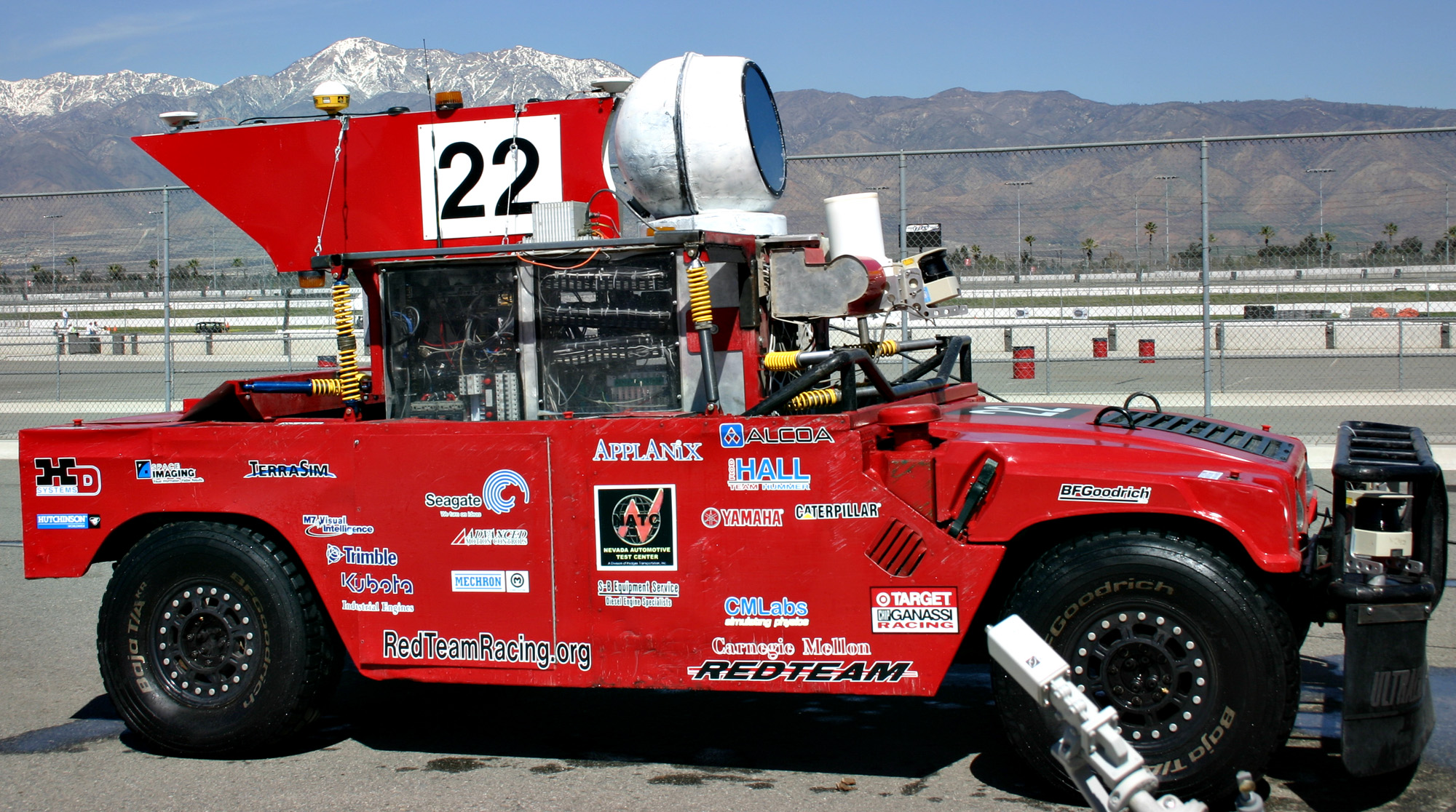
The modern autonomous-driving story did not begin in Silicon Valley, but in the Nevada desert in 2004 when the U.S. Defense Advanced Research Projects Agency, better known as DARPA, organized the first Grand Challenge to push autonomous vehicles through a 142-mile course. The objective was simple to describe and extraordinarily difficult to achieve: build a vehicle capable of navigating the course without a human driving it. Ultimately, none finished and the $1 million prize went unclaimed, a failure that established a recurring pattern by demonstrating that showing a technology is possible in principle is very different from making it reliable in the real world.
One year later, the situation changed dramatically during the 2005 Grand Challenge when Stanford University's autonomous vehicle Stanley completed the course and won the $2 million prize alongside four other finishers, proving that autonomous navigation was no longer merely a theoretical research problem. Although primitive by today's standards—relying on combinations of LiDAR, cameras, radar, GPS, inertial sensors, computer vision, digital maps, and algorithms for localization, obstacle detection, and path planning—the basic architecture of autonomous driving was already emerging. Machines had to perceive the environment, determine where they were, understand what was around them, decide what to do, and control the vehicle accordingly.
In 2007, DARPA raised the difficulty again with the Urban Challenge, moving autonomous vehicles into roads, intersections, moving traffic, merging, passing, parking, and interactions with other vehicles. Six vehicles completed the competition, which was won by Carnegie Mellon University's Tartan Racing team. The importance of DARPA's competitions went far beyond the individual races; as DARPA itself later described, the challenges helped create a research community whose work contributed to subsequent autonomous-vehicle research and commercial applications. In other words, DARPA did not build the autonomous-car industry, but helped create the technical language, talent, and competitive environment from which that industry emerged. Many of the people who worked on those early systems later became central figures in the industry, such as Chris Urmson, who participated in Carnegie Mellon's DARPA effort before becoming one of the leaders of Google's self-driving-car project and co-founding Aurora. The autonomous vehicle industry had been incubating for years before appearing in the 2010s.
The First Autonomous Vehicles Were Already AI Systems
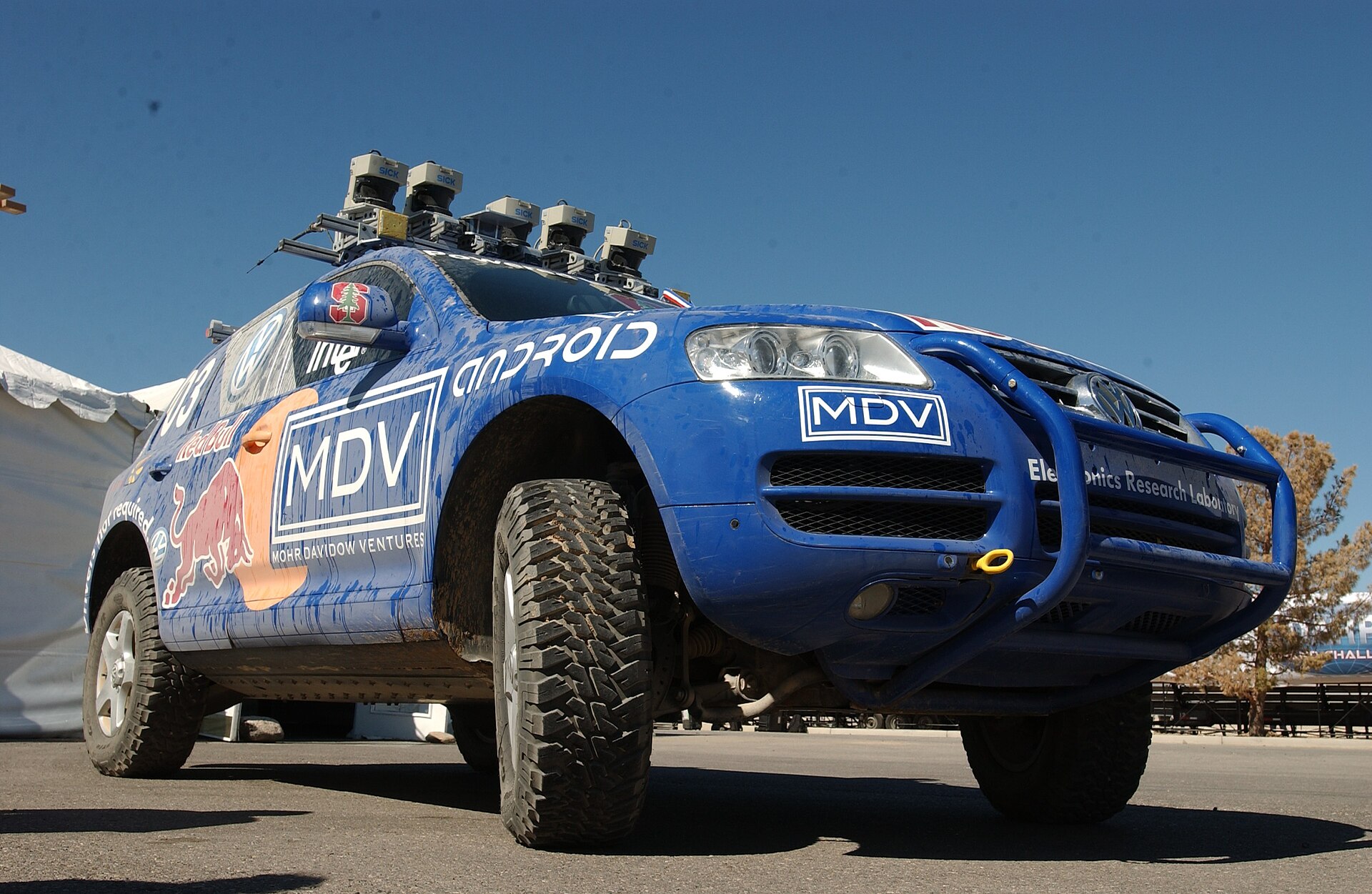
It is tempting to divide the history into an old era of rules-based robotics and a new era of artificial intelligence, but early DARPA vehicles were already intelligent machines in the engineering sense that perceived the world, estimated their position, classified obstacles, predicted possible trajectories, and planned paths. What they generally did not have was the kind of large-scale neural-network intelligence that would later dominate the field. Because much of the early software was explicitly engineered with human-defined rules and mathematical models for sensor calibration, localization, mapping, obstacle avoidance, and decision-making, these systems could perform surprisingly well in the constrained environments for which they had been designed. However, this approach had an inherent limitation: the real world does not follow a complete rulebook. There are millions of situations that engineers cannot anticipate individually, such as an unusual object in the road, an unpredictable pedestrian, a temporary road closure, a police officer giving an unusual hand signal, construction workers creating an improvised lane, an animal crossing, or another driver behaving irrationally. The more autonomous driving advanced, the more obvious it became that while you could write another rule, there would always be another exception. That reality opened the door to a different approach: instead of telling the computer exactly what every object looks like and how every situation should be handled, allowing the machine to learn patterns from enormous amounts of data. The DARPA challenges ultimately ended after the 2007 Urban Challenge, having demonstrated that autonomous navigation could progress from experimental desert vehicles to complex urban driving. More importantly, they helped create a research community whose members would go on to shape the emerging autonomous-vehicle industry. As the major DARPA competitions concluded, attention increasingly shifted toward translating the technology into commercial applications. Veterans of those university and military challenges —such as Carnegie Mellon researcher Chris Urmson, who worked on Carnegie Mellon’s DARPA autonomous-vehicle projects before helping lead Google’s self-driving program and later co-founding Aurora—moved into the commercial sphere. They went on to populate a new generation of autonomous-driving companies and programs, including Google’s self-driving project, Cruise, and, later, Aurora.